Africa
Morocco: where to go and how to plan a first trip
Morocco is close to Europe and feels a world away. On a single trip you can wake in a walled medina, cross high mountain passes and watch the sun go down over the dunes. The cities are full of craft, colour and noise, the mountains are quiet and green in spring, and the Atlantic coast stays cool and breezy when the interior bakes.
It is one of the most rewarding countries we plan, and one where the shape of the trip matters as much as the hotels. There are wonderful places to stay at every turn, from riads behind unmarked doors to palaces, kasbahs and desert camps. This guide shows where to go, how the regions differ and how to put a first trip together.
Needful Travel Bureau5 min read
Where to go
Natural Earth · MapLibre
Showing the map overview. Use the arrows to pan when the map has focus.
- Marrakech
- The High Atlas
- Ouarzazate, Skoura and the kasbah valleys
- The Sahara: Erg Chebbi and Erg Chigaga
- Fez, Meknes and Volubilis
- Chefchaouen
- Rabat and Casablanca
- Tangier
- Essaouira
- Oualidia
- Taghazout and Agadir
- Tamuda Bay
- Marrakech, the Atlas and the Sahara
- The imperial cities and the north
- The coast
Marrakech, the Atlas and the Sahara
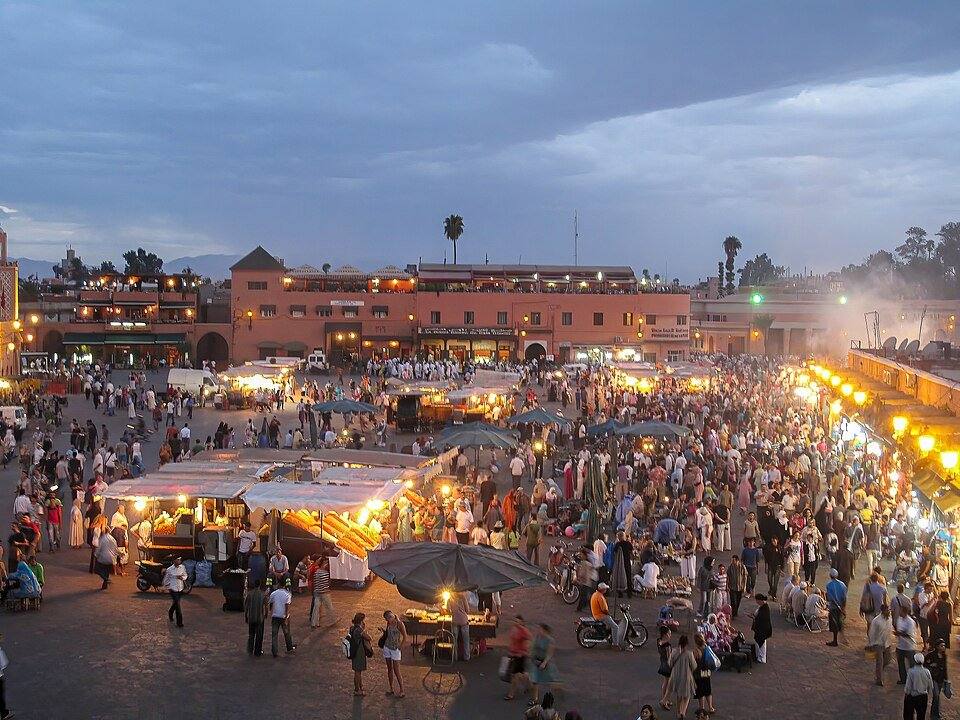
Marrakech is the hub of the south, with mountains, kasbahs and dunes beyond it.
Marrakech
Go for the souks and the great square at dusk, gardens and palaces, and riads, palaces and resorts of every kind.
Skip it if you want calm: the medina is crowded, loud and persistent, and summer is fiercely hot.
Worth knowing. Typical July highs are near 38°C and January highs near 19°C, so spring and autumn suit walking. The Palmeraie, 15 to 20 minutes out, trades the medina for space and big gardens.
Best months. March to May, October and November.
Our guide: The best luxury hotels in Marrakech: which to book and why
The High Atlas
Go for walks between Berber villages, views of Toubkal and cool, quiet nights after the city.
Skip it if you want a resort with plenty to do: evenings are quiet and the mountain roads are slow.
Worth knowing. Imlil is about 63 km from Marrakech. The valleys are still rebuilding after the 2023 earthquake, and visitors are welcome. From December to mid-April, snow can stop a climb to the Toubkal summit.
Best months. April, May, September and October.
Our guide: The Atlas Mountains and the Sahara: where to go and stay
Ouarzazate, Skoura and the kasbah valleys
Go for kasbahs and fortified villages such as Aït Ben Haddou, the Skoura palm grove and the rose valley in May.
Skip it if you are short of time: Ouarzazate is about four hours from Marrakech over the Tizi n'Tichka pass.
Worth knowing. Ouarzazate has flights from Casablanca, which saves the mountain drive one way. The rose festival at Kelaat M'Gouna is usually in early May.
Best months. March to May, October and November.
Our guide: The Atlas Mountains and the Sahara: where to go and stay
The Sahara: Erg Chebbi and Erg Chigaga
Go for real Saharan dunes, a camel ride at sunset, silence and the stars.
Skip it if you have fewer than three days to give it from Marrakech, or you are travelling in high summer.
Worth knowing. Erg Chebbi, by Merzouga, has the taller dunes and easier roads, about 560 km from Marrakech. Erg Chigaga, beyond M'Hamid, is wilder and quieter, with the last stretch by 4x4. Winter nights fall close to freezing.
Best months. March, April, October and November.
Our guide: The Atlas Mountains and the Sahara: where to go and stay
The imperial cities and the north
Fez and the north are linked by train, and suit a trip that starts in Tangier or Spain.
Fez, Meknes and Volubilis
Go for the largely car-free old city of Fes el Bali, its tanneries, madrasas and workshops, with Meknes and the Roman ruins of Volubilis for a day out.
Skip it if you dislike crowded lanes and getting lost: a guide for the first half day helps.
Worth knowing. Meknes is about 45 minutes away by train. Fez is seven hours or more from Marrakech by train, so pair it with the north, or drive south through the Middle Atlas to the dunes.
Best months. March to May, October and November.
Our guide: Fez, Rabat, Casablanca and Tangier: where to go and where to stay
Chefchaouen
Go for blue lanes and stairways under the mountains, a slower pace and walks in the hills around.
Skip it if you want more than a stop: it is best for a few hours or a single night on the way north.
Worth knowing. The north is far wetter than the south, and most of its rain falls from October to April.
Best months. April to June, September and October.
Our guide: Fez, Rabat, Casablanca and Tangier: where to go and where to stay
Rabat and Casablanca
Go for Rabat's kasbah above the river mouth, its gardens and quiet streets, and Casablanca's Hassan II Mosque and Art Deco centre.
Skip it if you came for souks and riads: both are polished modern cities.
Worth knowing. Rabat is 1h20 from Tangier on the high-speed train. Casablanca has the main international airport and the domestic flight hub, so a night there can make sense at either end.
Best months. All year; best from April to June and September to November.
Our guide: Fez, Rabat, Casablanca and Tangier: where to go and where to stay
Tangier
Go for the kasbah and medina above the Strait of Gibraltar, café terraces and views across to Spain.
Skip it if you want a beach resort: Tamuda Bay, east along the Mediterranean, suits that better.
Worth knowing. Ferries from Tarifa cross in about an hour to the port in the city centre, and the high-speed train reaches Casablanca in 2h10.
Best months. May, June, September and October.
Our guide: Fez, Rabat, Casablanca and Tangier: where to go and where to stay
The coast
The Atlantic is cool and windy, the Mediterranean warm and calm in summer.
Essaouira
Go for the ramparts and fishing harbour, an easygoing medina and long beaches for wind sports.
Skip it if you want to lie on the beach: the trade wind blows on most days from spring to late summer.
Worth knowing. It is two and a half to three hours from Marrakech. Typical summer highs stay near 22°C while Marrakech is near 38°C. Flights from Casablanca began in autumn 2026.
Best months. April to June, September and October.
Oualidia
Go for a calm saltwater lagoon behind the Atlantic, kayaking, birdlife in spring and autumn, and oysters.
Skip it if you want nightlife or a lot to do: it is a village, and August fills with Moroccan families.
Worth knowing. It is about two hours from Casablanca airport and about three from Marrakech, so it works at the start or end of a trip.
Best months. May, June, September and October.
Taghazout and Agadir
Go for surf from October to April, gentler waves for beginners in summer, golf, and large beach resorts with mild winters.
Skip it if you want old Morocco: Agadir is a modern resort city and Taghazout a surf village.
Worth knowing. Typical January highs at Agadir are about 21°C, the mildest winter on this coast. Agadir airport is 45 minutes to an hour from Taghazout.
Best months. October to May.
Tamuda Bay
Go for calm, warm Mediterranean water, polished beach resorts and Tétouan's medina nearby.
Skip it if you travel in winter: from November to March it is quiet and fewer services open.
Worth knowing. Tangier airport is about an hour away. July to September is the season, and August is the busiest month, with Moroccan holidaymakers.
Best months. June to September.
Things to consider
Five nights. Three nights in Marrakech, then two in the High Atlas or out at Agafay. Or swap the mountains for Essaouira and the sea air. Both keep the driving short and leave time to slow down.
Seven nights. Marrakech for three, one in the Atlas, then over the Tizi n'Tichka to Skoura for two and a night at a camp in Erg Chigaga. Fly home from Ouarzazate via Casablanca, or drive back.
Ten nights. Arrive in Fez for two or three nights, drive south through the Middle Atlas to Erg Chebbi, then west through the kasbah valleys to Marrakech. Finish in Essaouira or the mountains.
Trains and Al Boraq. The high-speed Al Boraq links Tangier with Rabat in 1h20 and Casablanca in 2h10. Classic trains continue to Marrakech and Fez. Book first class, with six-seat compartments, as seats sell out.
Drivers. There is no railway beyond Marrakech. For the Atlas, the kasbahs and the desert, a private driver is the way to travel: Ouarzazate is about four hours away, Merzouga more than eight and a half.
Internal flights. Royal Air Maroc flies from Casablanca to Ouarzazate, Zagora and Errachidia, the airport for Erg Chebbi, and now to Essaouira. A flight one way saves a long drive back.
What to pair. Andalucía is the natural partner: ferries from Tarifa reach Tangier in about an hour. A beach at the end suits a desert loop: Essaouira or Oualidia from Marrakech, Tamuda Bay from the north.
When to go. Spring and autumn suit the whole country. Winter is good for Marrakech and the coast but cold in the mountains, and summer is for the coast. Our month-by-month guide has the detail.
Our insight
What we would tell a client before they book.
The Tizi n'Tichka in winter. Snow closed the pass between Marrakech and Ouarzazate in December 2025 and again in January 2026. From December to March, leave a spare day between the desert and an international flight from Marrakech.
Ramadan in 2027. Ramadan is expected to begin around 8 February, in the best weather of the year in the south. Morocco puts its clocks back an hour for the month, so check transfer times against flights.
Fez and Marrakech. They are a long day apart by road or rail. Fly into one and out of the other, and make the desert the route between them.
Arriving at a medina riad. Cars cannot enter most of the old city in Fez, and taxi drivers may not know the best gate. Ask the riad which gate to use and to send someone to meet the car and carry the bags.
The south in high summer. Even some of the best kasbah stays close for a few weeks from mid-July, and typical July highs at the edge of the Sahara are near 40°C. In July and August, look to the coast and the mountains instead.
At a glance
| Place | Best for | What you will not get | Best months |
|---|---|---|---|
| Marrakech | The natural first base: souks, gardens, palaces and the widest choice of places to stay. | Calm in the medina | March to May, October and November. |
| The High Atlas | Walking, mountain air and village life within easy reach of Marrakech. | Nightlife or much to do after dark | April, May, September and October. |
| Ouarzazate, Skoura and the kasbah valleys | Earth-built kasbahs, palm groves and a gentler way towards the desert. | A quick trip from Marrakech | March to May, October and November. |
| The Sahara: Erg Chebbi and Erg Chigaga | A night or two among the great dunes, and a sky full of stars. | A short trip from Marrakech | March, April, October and November. |
| Fez, Meknes and Volubilis | The great medieval medina, and the craft that still fills it. | Easy wandering on your own | March to May, October and November. |
| Chefchaouen | The blue-washed town of the Rif, on the way between Fez and Tangier. | Enough for a long stay | April to June, September and October. |
| Rabat and Casablanca | The calm modern capital and the big Atlantic city, both easy by train. | The Morocco of souks and riads | All year; best from April to June and September to November. |
| Tangier | The gateway from Spain, with a hilltop kasbah over the strait. | A beach resort | May, June, September and October. |
| Essaouira | A walled fishing port and the easiest seaside escape from Marrakech. | Still days on the beach in summer | April to June, September and October. |
| Oualidia | A quiet lagoon, oysters and birds, for a few slow days. | Nightlife | May, June, September and October. |
| Taghazout and Agadir | Surf, golf and winter sun on the southern Atlantic. | Old medinas and riads | October to May. |
| Tamuda Bay | Mediterranean beach resorts in summer, close to Tangier and Tétouan. | Life out of season | June to September. |